
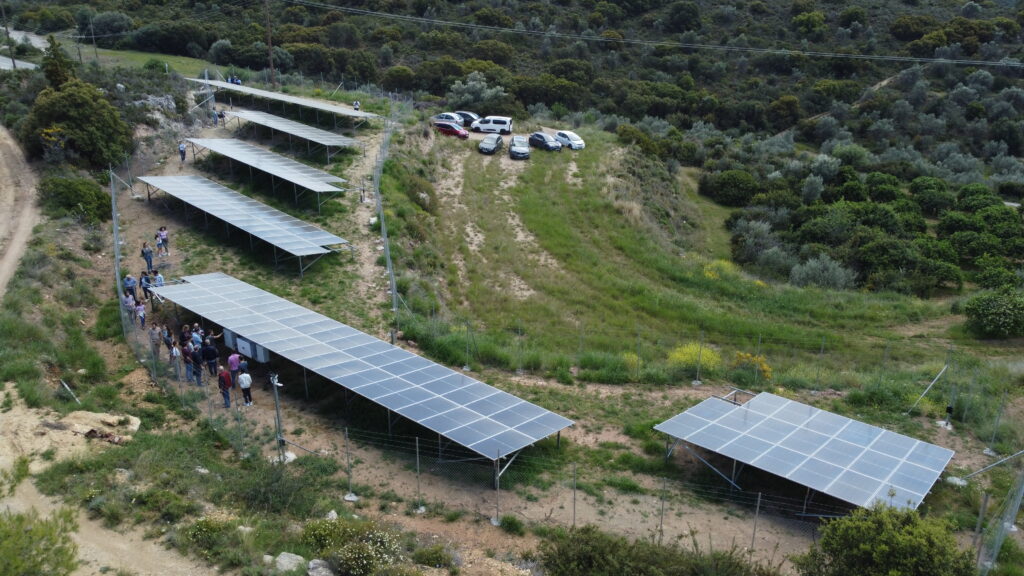
The Greek pilot is taking place in two areas of the country, with a PV park producing electricity in Argolida in the Peloponnese region and the dwellings of members of the energy community located in Athens in the adjacent Attica region.
The PV park was implemented by the Collective Energy Community (CoEN).
The pilot is focused on the development and operation of a community-owned solar plant under a virtual net metering scheme. The broader aim of the pilot is to contribute to a just and inclusive energy transition by enabling collective self-consumption and reducing energy costs for members.
More specifically, CoEN aims to:
• Provide affordable, locally produced renewable energy to members:
• Address energy poverty by including vulnerable households;
• Strengthen citizen participation and collective ownership in the energy system,
• Test and demonstrate community-based energy models that can be replicated in other regions.
This aligns with the overall mission of CoEN to develop sustainable energy solutions and empower citizens through collective action.
Currently the PV park is operational, with energy production under way since February 2024.
The community has successfully moved from the development phase – including permitting, construction and grid connection – to the implementation of collective self-consumption.
Members are receiving benefits through the virtual net metering scheme, marking an important milestone in the energy project’s lifecycle.
At the same time, the pilot is still in an active operational and optimisation phase, as the community continues to monitor performance, manage energy allocation and improve communication and understanding of the system among members.
CoEn has also expanded its social impact, with the inclusion of vulnerable households identified in collaboration with local authorities, reinforcing its social dimension.
Pilot challenges
The pilot has faced a wide range of interconnected challenges, reflecting both the specific Greek context and the structural barriers affecting energy communities more broadly.
A central challenge has been the lack of transparency in the virtual net metering process. Members do not have consistent, detailed and real-time access to data on how their energy production is being allocated and offset in their electricity bills. This creates uncertainty, limits the ability to verify benefits, and undermines trust in the system.
Closely linked to this is the dependence on external actors, such as electricity suppliers and grid operators, for the implementation of energy sharing. Energy communities have limited control over these processes and delays or lack of responsiveness from these actors can significantly affect project performance and member experience.
At the regulatory level, the Greek framework remains unstable and often unsupportive. Frequent policy changes – particularly the shift from virtual net metering to new net billing schemes – have created uncertainty and slowed down the development of new energy projects.
In addition, energy communities have been excluded from key funding opportunities and have not received the level of institutional support foreseen at the European level.
Another major barrier is related to grid capacity constraints, which limit the development and expansion of new renewable energy projects. This is a systemic issue in Greece and has delayed many community-led initiatives.
Administrative complexity has also been a significant challenge. The development and implementation of the pilot required navigating complex bureaucratic procedures, involving multiple stakeholders (ministries, regulators, DSOs, suppliers), often with unclear processes and long timelines.
Finally, there are structural challenges related to financial sustainability and scaling. Access to financing remains limited, while the current market and regulatory conditions do not provide strong incentives for the growth and replication of community energy projects.
Lessons
One of the most important lessons is that transparency and access to data are fundamental for the success of energy communities. Without clear and reliable information on energy production and allocation, it is difficult to ensure accountability, build trust, and maintain active member participation.
Another key lesson is that community energy projects are not only technical but deeply institutional. Their success depends not only on technology and organisation, but also on the regulatory environment, the responsiveness of institutions and the existence of supportive policies.
Finally, the experience confirms that energy communities can act as laboratories for innovation, testing new models of collective energy use, participation, and governance that can inform broader energy policy and practice.
Next steps
The next steps focus on both improving the current pilot and strengthening the long-term development of the community.
A key priority is to improve transparency and data access, including advocacy towards regulators and suppliers for better monitoring tools, clearer billing information, and stronger oversight mechanisms.
At the same time, CoEN is progressing with its transition to the new legal form of a citizens energy community, in line with recent national legislation, in order to strengthen its institutional position and expand its activities.
Future actions include:
• Expanding membership and increasing participation;
• Strengthening member engagement and energy literacy;
• Exploring new services such as energy flexibility, demand-response and energy efficiency;
• Developing new collective energy projects that build on the experience of the pilot.
Overall, the community aims to scale its impact while continuing to promote a democratic, inclusive, and locally rooted energy model.