
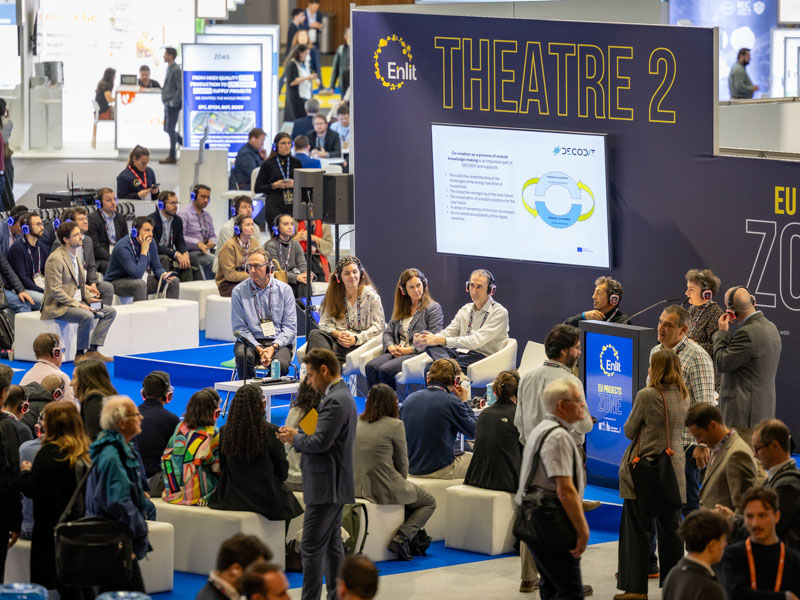
DECODIT project participants presented a full overview and update in a project hub session for attendees at Enlit Europe 2025 in Bilbao, Spain in November.
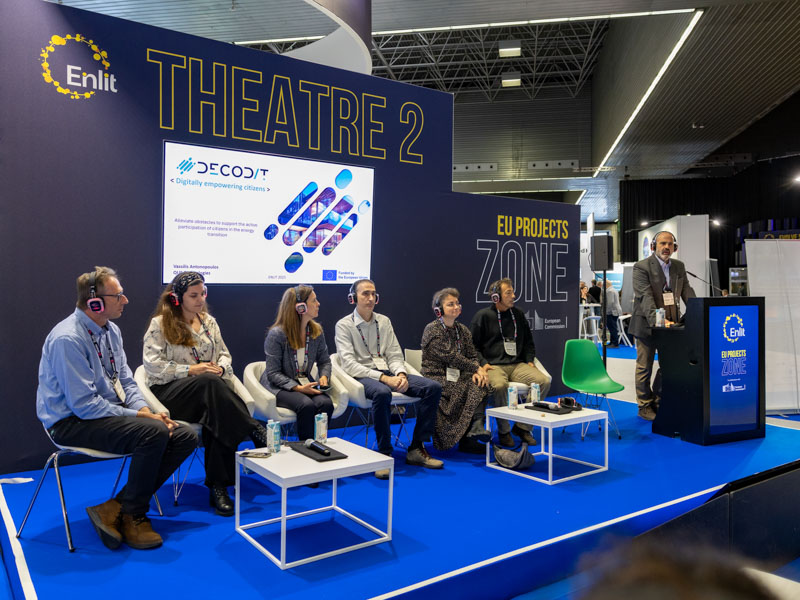
Setting the tone for the session, moderator and strategy lead Antonis Papanikolaou from Que Technologies reminded that the project was submitted to address the call of the European Commission for solutions on uptaking digital services in the energy market.
Opening the presentations, Vassilis Antonopoulos, project technical lead at Que Technologies, described DECODIT as a “bridge” between consumers faced with a maze of energy options for the energy transition of their homes and service providers requiring data to develop and personalise their services.
He explained that DECODIT is building three toolboxes – for energy and flexibility management, green retrofitting, energy efficiency and building renovation support, and financing, and that these will be provided to users through a mobile app incorporating an AI agent with a natural language interface.
“We’re trying to create a one-stop-shop for users and are investing a lot in co-creation and service design to ensure they are seamlessly embedded in their daily routines.”
He added that an innovative methodology has been developed for a baseline assessment of the energy literacy of citizens in order to be able to measure the improvement at the end of the project.
Co-creation and service design
Aggeliki Aggeli, Assistant Professor at Aalborg University, outlined the co-creation process that has been implemented, starting with a ‘staging’ in living labs with energy communities, with the input then subject to evaluation and negotiation within the project consortium for a reframing of the materials and tools.
Currently in the fourth of six planned co-creation cycles, workshops with communities are still under way and a start is being made on the process of understanding and evaluating energy literacy.
“We consider energy literacy to be not only a technology driven concept but to include practical knowledge and linkage to the social and cultural aspects in users’ communities,” she commented.
Lia Patricio, board member at INESC TEC and Associate Professor at the University of Porto, addressed the service design methodology, highlighting that it is very much about understanding the energy users and translating that into the digital services that are being developed.
“We have adopted an iterative service design approach, which started with framing the problem and have gone through an exploration phase to understand users’ energy practices,” she explained.
She added that a novel aspect of the project is the focus not only on digital services that are well accepted but also on those that might help users adopt more sustainable energy practices and empower them for the energy transition.
Currently the ideation phase is underway of matching the users’ energy practices to services, which will then be prototyped in the four pilots.
Pilot experiences
Antonio Soler, who is co-leading the Spanish demo in Murcia – one of the four demos being implemented – said it is involving 28 homes controlling loads including hot water and air conditioning among others.
“Connecting all the devices, solving connectivity problems and feedback from meetings with technical teams are all opportunities for engagement,” he said, adding other learnings so far as the need for simplicity and the ready access of the pilot leader to users.
“One of the main risks we face is a lack of engagement with users, for example due to delays or when systems are being implemented. Making things easy is key and it’s not only in the terminology but also in explaining what is happening within the homes and guiding users in the project.”
Maria Valliou, representing the Greek pilot at the CoEn energy cooperative in Attica, said a survey and workshop with members had provided valuable insights, such as the need for flexibility in user availability and multiple levels of engagement for users who are active and those less so.
“Two levels of engagement is a good compromise because it doesn’t increase the management much,” she said, adding that it is essential to provide all the relevant information, such as on the GDPR and data privacy.
She also noted the importance of social events in enabling users to create stronger bonds within their communities.
DECODIT tools
With the app the main engagement tool with users, Panos Tsarchopoulos, head of EU projects at Pragma IOT, highlighted that the AI assistant, as its core component, is not just a chatbot but is intended as a personal energy assistant.
“It transforms complex raw energy data into practical advice to the users and is accessible from every screen in the app, where the user can start the conversation and receive answers in plain language.”
For example, if the user asks the assistant which appliance consumes the most energy in their home, it would respond with explanation on the devices and their energy consumptions and then suggestions and actions for reducing these consumptions.
“We have made progress in all the work packages and are moving in line with what has been promised,” said Stratis Kanarachos, project lead for DECODIT, summing up the project’s progress almost half way into its second year at the latest plenary.
“The app is architected on a digital twin for each users’ building or apartment combining all otherwise siloed data and it supports the three toolboxes on energy management, renovation support and financing and uses all of these to provide the answers to their questions and to empower them with easy to use tools.”