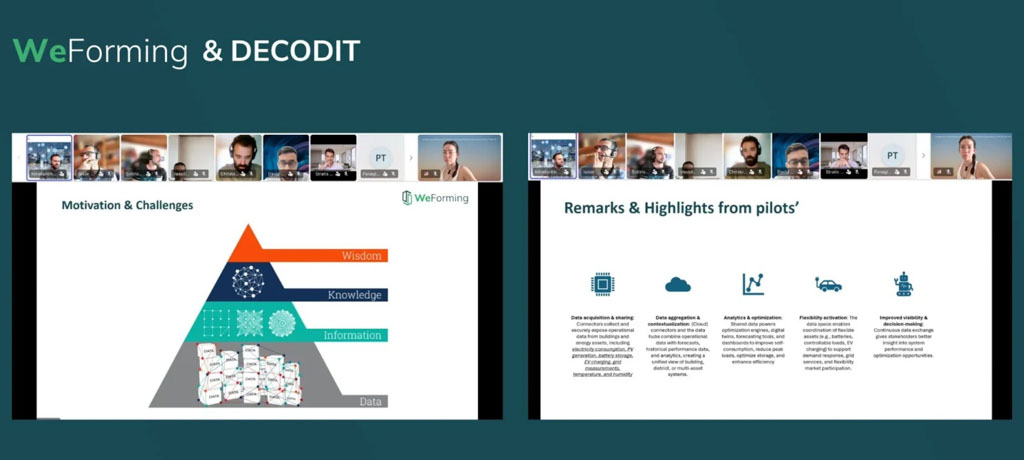
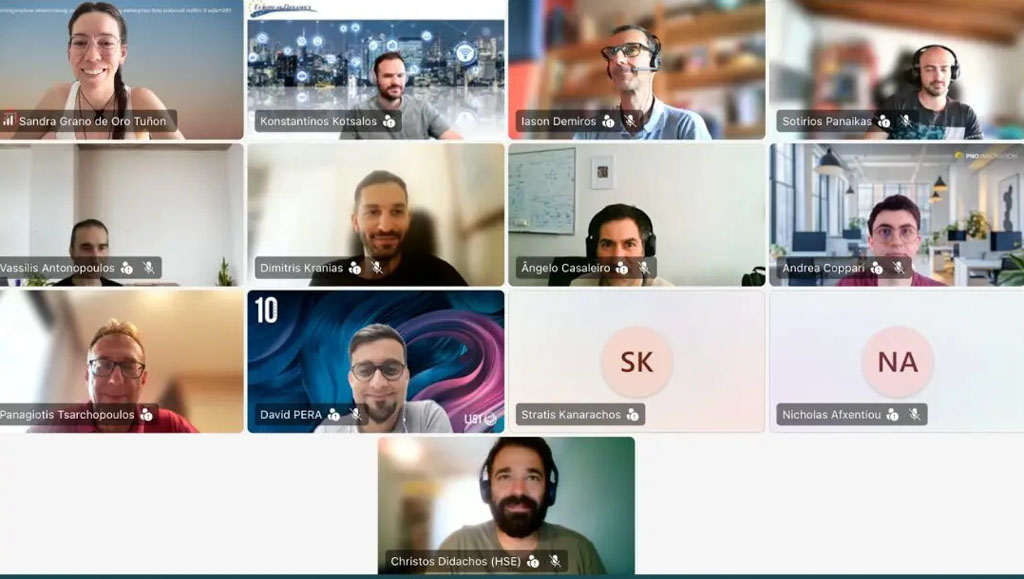
Members of the DECODIT and WeForming project consortia held a joint technical workshop on 24 June focussed on technical alignment and collaboration to support the building of the common European energy data spaces.
Currently data is largely fragmented across different apps and organisations and the aim of common European energy data spaces is to establish a standardised and secure framework for the sharing and exchange of data.
For example for building energy management or flexibility these may encompass solar PV, heating and cooling systems and electric vehicles.
With DECODIT focussed on data at the level of private homes and individual smart appliances and WeForming primarily on the higher system, district and aggregation layer, the two projects provide a complementary but end-to-end approach to consider the data exchange challenge and to bridge a crucial technical gap in the European energy ecosystem.
To prevent the technical fragmentation caused by incompatible technologies, the two projects are actively building towards a unified framework or smart middleware.
Why data spaces
The EU’s drive towards unified data spaces is centred around the three core principles of data sovereignty, value creation and monetisation and innovation.
These are aimed to allow users to keep full control over their own data, while also allowing them to safely share energy metrics and receive tangible financial rewards or services in return and enabling the development of the next generation of digital tools and solutions.
Turning messy data into intelligence
The energy sector faces some unique data challenges, including broken streams, missing information or hardware connectivity issues.
The workshop highlighted the structured workflow required to transform this raw, messy data into high value operational insights:
- Information layer: Raw hardware streams are combined with essential metadata and time-stamps to make the data actionable.
- Knowledge layer: Data is structurally mapped using open international standards and ontologies to create a clear semantic model.
- Wisdom layer: Automated control tools or third-party energy experts use this unified data pipeline to make optimal energy management decisions for the end-user.
Addressing stakeholder demands
During the workshop, the partners evaluated how data spaces directly answer the distinct demands of modern energy stakeholders:
Building owners and citizens are looking for automated energy recommendations to lower their utility bills via user-friendly apps. They are less interested in the technical data space itself and more focused on the automated microservices it enables.
Service providers require secure access to building-level data to offer advanced energy flexibility and efficiency optimisation services.
Grid operators (DSOs) are interested in consumer consumption trends to handle frequency regulation and improve peak demand forecasting.
In conclusion the workshop found that while technical challenges remain – such as managing high seasonality when properties are empty for parts of the year, or handling home router changes that interrupt data streams – the projects are deploying robust, plug-and-play hardware and compression solutions to keep data flowing reliably.
With acknowledgement to WeForming for summary and images.